Can Back Feeding a Transformer Damage the Transformer
A backup power system must be installed and used properly to avoid personal injury and/or damage to property.
- Backfeed Safety
- Engine Operating Safety
- Electrical Safety
- Battery Safety
Backfeed Safety
Special precautions must be taken whenever an independent electrical power source is connected to a building electrical system. This is because any inadvertant backfeed into the utility system would be a hazard to repair personnel and possibly to neighboring customers. It would also be dangerous when the utility power is restored since the relatively small backup generator could be destroyed. For example, consider the situation of a home that has lost power due to a fallen tree. In the figure below, the tree has taken down the high voltage line near the service to this home.
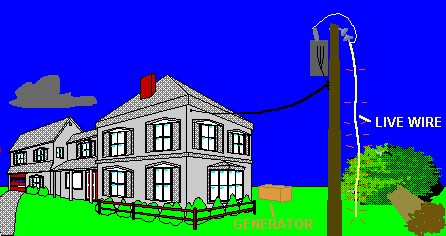
The home generator has been started and is providing power to the electrical circuits in the home. However, if there is no transfer switch and the main service disconnect is left in the closed position, voltage will be conducted outside and through the service drop up to the pole-top transformer. Utilities use a number of standard distribution voltages depending upon the area of the country. If the voltage in use is 12,470/7,200 V, the transformer will step the 120/240 volt service back up to 7,200 volts! In the figure above, this voltage would appear on the normally bare, but in this case broken and dangling, conductor creating an extremely dangerous shock hazard. A utility worker, and anyone else who happens to touch that conductor would most likely be killed.
Even in cases where there is no downed wire, there are risks if a transfer switch is not used. For example, assume the fuse on the pole-top transformer opens causing a loss of power, and the home generator is started and connected without opening the connection to the pole. A utility worker could arrive, replace the fuse, and restore the service. The restored utility power would at a minimum damage the generator, and at worst cause a fire.
Various hypothetical conditions can be imagined to create other similar backfeed hazards, even for underground services powered from pad mounted transformers.
In some localities, it is actually against the law to connect a permanently installed or portable generator to another power source. Article 702.6 of the National Electric Code requires the use of a transfer switch to prevent inadvertent backfeeding of electric power from generator into utility system which can be a safety hazard. If you own or operate a backup power source, you are responsible for ensuring that its power cannot backfeed into the utility system.
An additional consideration is the homeowner's insurance. If the home is damaged by fire or someone is injured or electrocuted as a result of improperly connecting a generator without a transfer switch, insurance claims might not be paid.
In conclusion, if you have a backup power source, there are only two correct choices:
- Do not connect it to your building's wiring at all--just use extension cords, or
- If the source will be connected to the building's wiring, install a two position
transfer switch or transfer panel to prevent backfeed into the utility.
Have a licensed electrician install your backup system, or at least have it inspected by a licensed electrician or your local authority. Some utilities also request that you notify them if you have a backup power system.
Engine Operating Safety
Whenever an engine is used, there are hazards associated with the flammable fuel and with the combustion products, particularly carbon monoxide. There is some degree of risk also related to contact with hot parts of the engine, fast rotating parts, etc.
Electrical Safety
Even though your backup power source is most likely limited in capacity, it can still cause electrocution and overheating if not used properly.

- Carefully read and follow all of the manufacturer's instructions.
- Ensure that the total load on your backup power source is maintained within its rating.
- Never install two male plugs on the two ends of the same electrical cord. Some refer to this as a suicide cord because the live exposed prongs are a shock hazard. If a transfer switch is used this type of cord is not necessary.
- Don't let electrical cord s be tripping hazards. This is an extra concern during a power outage when normal
lighting may not be available.
- Don't overload extension cord s. Overheated cord s can cause fires.
- Don't run cord s under carpets where heating can be increased and damage hidden.
- Don't use cord s with damaged insulation or exposed conductors. These have caused fires.
- Stay away from and report downed power lines.
- Never use water on an electrical fire.
- Install and regularly test your smoke detectors.
- Respect electricity!
Battery Safety
Batteries are usually installed and forgotten until they need to be replaced. They normally operate quietly and reliably. This is true of both dry cells and for lead acid batteries used in vehicles and in deep cycle applications. However, lead acid batteries can be dangerous due to the fact that they contain sulfuric acid and because they produce explosive hydrogen gas inside the case when charging. When they are used properly and as long as the case and caps or vents are intact they cause no problems. However, if the case has cracks or gaps around the posts, or if the vents or caps allow a path for hydrogen and external sparks to meet, there can be a hydrogen explosion. Therefore, precautions should always be taken when working around lead acid batteries especially when making or breaking electrical connections for powering inverters.
- Read the manufacturer's instructions before using any backup power source such as an inverter.

- Wear eye protection and clothing protection when working around a lead acid battery.
- Because of the presence of sulfuric acid, avoid touching eyes while working near a lead acid battery.
- If battery acid contacts skin or clothing, wash immediately with soap and water. If acid enters eye, immediately
flood eye with running cold water for at least 10 minutes and get medical attention as soon as possible.
- NEVER smoke or allow a spark or flame in the vicinity of battery or engine.
- Be extra cautious to reduce the risk of dropping a metal tool onto battery. It might spark or short circuit battery
or other electrical part that may cause explosion.
- Make sure vent caps on battery are tight. As an extra precaution it is wise to place a damp cloth over any vent caps,
making certain it is clear of fan blades, belts and other moving parts.
- Power inverters contain capacitors and when they are initially connected to the dc supply will draw a high current
to charge the capacitors. This is normal and will usually result in a spark where the last connection is made.
Therefore, NoOutage.com recommends that this last connection be made AWAY from the battery. The following
sequence accomplishes this:
1) connect the inverter's negative terminal to the battery negative terminal;
2) connect a small gauge temporary insulated jumper wire at least several feet long to the battery positive terminal;
3) touch and hold this wire to the end of the inverter positive cable away from the vicinity of the battery
(a spark is normal and indicates the capacitors are charged);
4) remove the temporary wire and connect the positive cable from the inverter to the battery. (No spark should
occur if the capacitors are charged.)
This sequence is NOT covered by inverter instruction manuals that we have checked to-date.
- Be absolutely sure that you have properly identified the positive and negative terminals on the battery. Reversing
polarities when connecting the cables may blow the inverter internal fuses and cause permanent damage!
- Vehicle batteries are designed for starting duty, not deep cycle duty. Therefore, to avoid wearing out a vehicle
battery prematurely, it should not be left in a discharged state for more than approximately an hour. Either keep
the engine running to charge the battery, or run the vehicle frequently.
We welcome your feedback or questions. Click here to contact us.
See our Terms & Conditions before using information or ordering from this web site.
Copyright � 1999-2022 NoOutage.com LLC. All rights reserved.
Source: https://www.nooutage.com/Safety.htm
0 Response to "Can Back Feeding a Transformer Damage the Transformer"
Post a Comment